
Service Description
General information about photovoltaic panels
To get electricity from the sun, you need a solar panel that has a solar cell or multiple cells. The solar cell absorbs a part of the light particles that fall on it, called photons. Each photon contains a small amount of energy. When a photon is absorbed, it releases an electron of the solar cell material. Because each part of the solar cell is connected to a cable, a current will flow through it. The cell will produce electricity that can be used immediately or it can be stored in batteries.
The electricity is produced as long as the panel is exposed to light. The material that the solar cells are made of are semiconductors and they have a lifespan of at least 20 years. The efficiency of the solar panels will decrease over time. While the decrease rate of return is guaranteed by each manufacturer of the solar panels. The wear of panels is given by the environment and by their installation way.
The solar cells
The solar cells are of several types: mono-crystalline, polycrystalline, amorphous, thin-film, CIS (copper indium diselenide) and CdTe (cadmium Telluride), CIGS, etc. The difference between these cells consists in the structure and in the way how the atoms are arranged. This will give a specific aspect to each solar cell. The biggest difference consists however in the efficiency. The cell efficiency is measured in the percentage of the light energy converted into the electricity. The mono-crystalline and polycrystalline solar cells have almost the same efficiency as the largest of the many commercial solar cells on the market.
Lately, the CIS and CdTe solar cells began to be available on market in representative quantities.
The solar panels
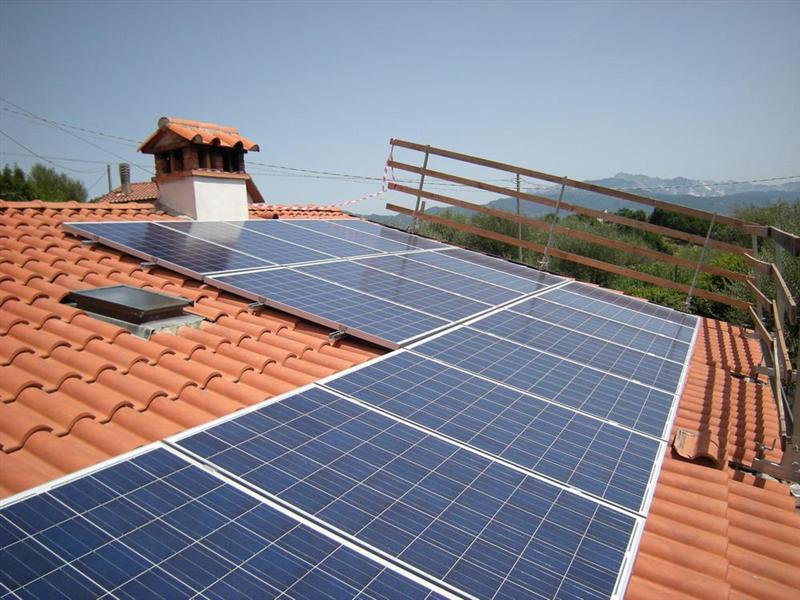
Solar panels are made of solar cells. Because a photovoltaic cell does not produce enough energy that can be used effectively, it needs more cells, these being connected in series – parallel, forming a photovoltaic panel.
The photovoltaic solar panels are manufactured in different sizes having various powers. The most used panels in residential range are the ones of 50 and 75 W, and for the high power photovoltaic solar panels of 220W.
The surface of a crystalline solar panel of 50 W is about 0.5 square meters.
The solar panels can be connected in their turn in series – parallel, forming higher power systems.
A solar system which will be connected to a single charger must have the same type of solar panels, the same manufacturer, same orientation and inclination and to not be partial in shade. If this is not possible, multiple chargers will be used.
The commercially available solar panels have an efficiency of between 5-15%. This means that 5-15% of the light energy will be transformed into electricity.
The worldwide laboratories develop solar panels technologies with much higher output (about 30%). The disadvantage of these solar panels with high efficiency is the high production cost. This thing led to the development of the thin film panels (thin film) which have a lower output, but their cost is small.
The solar radiation
The sun continuously emits huge amounts of energy. A part of this radiation reaches the Earth. The amount of energy that reaches the Earth in one day is greater than the entire consumption of the Earth during a full year. However, not all the sun’s energy reaches on the Earth’s soil. Some is absorbed by the atmosphere or reflected back into the Space.
The intensity of the light that reaches on the Earth varies by the time of day, location and weather conditions. The solar radiation that reaches on the Earth is measured in Wh /m2 per day or kWh / m2 per year. To simplify the calculations and to have a common basis of calculation, it was decided as standard a power of 1000Wh / m2 for an hour on a sunny day. This power is found in a summer day on an area of one square meter where the sun is perpendicular to it.
The solar radiation which falls on the ground varies both with the time of day, but can vary considerably depending on the location, especially in the mountainous areas. The solar irradiation varies between 1000KWh / m2 per year in the countries of the Northern Europe and from 2000 to 2500 kWh / m2 per year in the desert areas. These variations between locations are due by the latitude and the weather conditions.
The orientation
The light travels a straight line from the Sun to the Earth. On the entering in the Earth’s atmosphere, a part of the light spreads and a part arrives to the ground in a straight line. Another part of the light is absorbed by the atmosphere. The light which was spread in the atmosphere is what we call diffuse light or diffused radiation.
The ray of light that reaches on the soil surface without being spread is called direct radiation. The direct sunlight is the best known and it is felt directly by the people.
Only a small fraction of the solar radiation actually reaches on the Earth’s soil.
A solar panel produces electricity even when there is no direct radiation. So even if it is cloudy outside, a solar system will produce electricity. However, the best conditions for obtaining the electrical energy are in the sunny days, and the panel pointed directly to the sun. If you do not opt for systems of automatic guidance depending on the sun, there will be made a compromise in the settlement of the panels. For the areas that are in the North hemisphere, the panels will be placed to the South and for the Southern hemisphere, they will be placed to the North.
A small deviation from the optimal orientation will not have a significant effect in the annual electricity production.
The angle of inclination
The sun travels across the sky from the East to the West. The solar panels have a higher output if they are oriented perpendicular to the sun at midday, when the light intensity is the highest. The most solar systems are placed on the roof on a metal frame with a fixed position unable to follow the sun during the day. The angle between the horizontal plan and the solar panel is called angle of inclination.
Because the Earth rotates around the sun, there are variations depending on the seasons. The sun will not reach the ground at the same angle in winter and summer. The position of the panels in summer is more horizontal than in winter. This position could disadvantage the energy production in winter, so there will be a compromise between these two situations.
For each latitude there is an optimum inclination angle. Only in areas very close to the Equator, the panels can have an angle of inclination near to zero.
Deviation of 5 degrees from the optimum angle has a minor effect on the production of the electricity. The differences due to the weather conditions have a more important effect on the photovoltaic system. For the independent systems, the inclination angle can be chosen according to the needs of electricity in a certain month.
House Extension and Refurbishment in London.
Loft Conversion and Refurbishment in London.
House Refurbishment in London. New Build in London.
Flat Refurbishment in London. New Build in London.
Electricians and Plumbers in London. Refurbishment London.
Kitchen Furniture Fitting in London. Cleaning in London.
House Renovation and Refurbishment in London.
Office Refurbishment, Shop Refurbishment in London.
Bathroom and Kitchen Refurbishment in London.



Reviews
There are no reviews yet.