

Service Description
Sound insulation… for the noisy world!
The rain is beating on the window … the snow is beating on the window … the wind is beating on the window … the sun is beating on the window … do not open!
It is just the bad weather from which you need to know how to save yourself … it is best to do it all behind a window … but that is all the responsibility which fall only on the window’s shoulders.
It is good to know that the thermal performance of the windows can be improved, if it shows fewer negative points from the factory. The glass is, unfortunately, not a good quality thermal insulator. During the winter, for example, the window stays as a double border, between the minus temperature from the outside and the plus temperature from the house. However, closing a volume of air between two windows is a complex insulator. Other solutions would be the extra window, double glazing and double windows.
The double glazing consists of replacing the existing windows with insulating windows, which are in the form of two thin windows with a volume of dehydrated air blocked between them. Before fitting a window with double-glazing, you need to check its solidity to make sure that it can support the weight of the new windows.
You can also use the extra window that consists of assembling a frame with a second glass over the existing windowwings. The volume of air which is acting as an insulator will be between the old windows and the new frame window. Here, it is good not to confuse the double glazing with the extra one. If the double glazing is obtained from the factory, the extra window is obtained when you assemble the frame with the glass over the window. If you want to apply the extra window, you must first check the strength of the window, its mechanical strength, as the additional glazing implies an extra weight that can be supported by the window without deformation. If the window is old, opt for another solution or replace the wings.
Another solution that traditionally exists in mountain houses is the double window. Its effectiveness has been proven in many ways, but the large space it occupies does not make it advisable in all cases. Here is the assembling of a secondary window in front of the existing one, which remains in place. The glass of the existing window and of the new window must have different thicknesses.
The noise is another problem we are fighting. Even if it could coincide at one point, the fight against the cold and noise involves different solutions. Ideally it would be to have windows that respond to both requirements, which is rarely true. An important role is played by the qualities of the wall in which the window is inserted. On the other hand, the woodwork can be chosen to absorbthe sound vibrations – the case with the special profiles made of PVC. It is useless to change the window if the window is in an inappropriate condition. The insulation is one thing: the masonry, the window case, wings, windows, garreting and blinds (all of which play complementary roles in the sound insulation). In any case, the sound insulation of the window is very important. Once taken into consideration and solved, you can carry a conversation on the phone or with a person in the house without a disturbing background sound and you can put your head on the pillow much quieter.
The improvement of the sound comfort – solutions for interior walls, floor and roof
In the previous article we presented solutions for improving the sound comfort of a house from the design step, as well as some facade solutions. We continue to improve the acoustic comfort of your house with a range of solutions that focus on the interior walls, the floor and roof.
Solutions for the interior walls:
– The interior walls must have a thickness bigger than 8 centimeters;
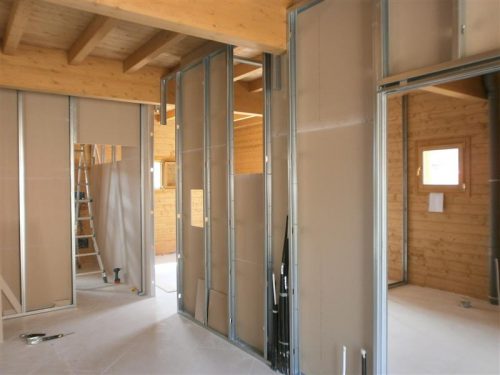
– Build walls with double structure.
– Limit the openings in the walls and improve the tightness of the door openings;
– Use plywood with heavy panels, 10-15 kg / square meter;
– The wall between the bathroom/washing and the bedroom needs a better sound insulation, which provides an acoustic resistance of over 40 dB. For this purpose it is necessary to double the plywood on the wall faces, to use heavy plywood panels, possibly using plywood made of different materials on the two sides of the wall.
To have a good sound insulation, here are some solutions for the acoustic insulation of the floor:
– The layering of the floor must be dissociated by the contour;
– The optimal distance between the floor beams must be 40 centimeters axle-axle;
– Make a false ceiling made of fiber reinforced plasterboard;
– Do not fix the ceiling directly on the beams, but on a network of wooden or metal rods;
– Pour the screed on a layer of granules or special mineral fibers;
– The cement screed must be at least 5 centimeters thick;
– Uses OSB panels as the ceiling support;
– Fill the holes in the floor with mineral wool.
Last but not least, pay attention to the sound insulation of the roof. The noise which the rain produces when it falls on the metallic tile is disturbing, so you could choose another material to cover the roof. Under the ceramic tile placed on a wooden framework you can make a sound insulation using 1.5 cm OSB panels + 20 cm mineral wool + plasterboards.
The sound insulation of the apartment
Your neighbors are laughing. They speak loudly, they are fighting, screaming, clapping the objects, listening to music with the maximum volume, thechildren show up in the house as in a playground in the park. Obviously, it all bothers you, especially when you get back tired from the work, maybe even from the third shift, and you want one thing: quiet to get some rest.
When you are deciding to soundproof an apartment or just a room, you have to take into account that there are two types of noise:
- Airborne noise is produced when a person speaks, screams or sings, so the noise is produced by the vocal cords.
- Impact noise is mechanical, caused by the vibration triggered by the impact of two objects, for example a ball hit in the wall or a man who jumps.
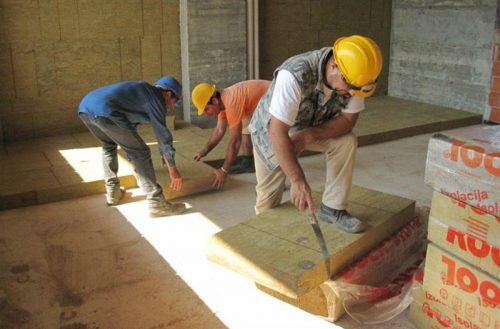
The soundproofing against the airborne noise is made with mineral glass wool. It has excellent sound-absorbing qualities, providing not only a very good sound insulation, but also a thermal insulation. The mineral wool is placed behind a false wall made of plasterboard or OSB. As an idea, as the wall and the mineral wool layer are thicker, the lesser the sound intensity will be.
The phonic insulation with mineral wool is a handy solution, but there are also more complex solutions especially designed for the sound insulation. It is the sound-absorbing soundproofing foam, which is used by the audio recording studios, HD Foam soundproofing panels, acoustic panels or the soundproofing membranes.
In terms of the sound insulation against the impact noise, if your neighbor has babies running and jumping through the house, the impact isolation will have to be done by your neighbor, using an reinforced screed and Isover acoustic panels for floorings on the elastic materials.
The sound insulation of the indoor rooms in a house
When you live in an apartment placed in a block or in a duplex style house, you are fighting with many types of noise. First, it is the outer daily noise. You hear the cars and trams running on the street or the children playing in front of the block. Then there is still the noise produced by the neighbors. You hear the music that your next neighbor listens to, or the noise that the child of the upper neighbor produces when he is running through the house. And there is still the noise which you produce, noise that you do not want to be heard by the neighbors or other family members. For example, you do not want your neighbor to hear when you are nervous and talking loud on the phone, or you do not want to hear from the bedroom the noise that the microwave and the refrigerator make in the kitchen.
Although there are no sound insulation regulations between different rooms in a house, we suggest you some recommendations for such insulations.
The most suitable solution is the mineral wool insulation. In principle, you get an approximately 20% increased progress in the acoustic resistance of the house components.
Here are some examples:
Simple wall, plated with 12,5 mm of plasterboard
– Without mineral wool, it has an acoustic resistance of R= 32 dB
– With a 50 mm thick of mineral wool, the wall reaches to an acoustic resistance of R = 35 dB
Simple wall, with double plasterboard-plywood on the both sides of the wall
– Without mineral wool, R = 43 dB
– With a 50 mm thick of mineral wool layer, it has an acoustic resistance of R = 45
In the case of a double-walled wall, the interspace of 20 mm between the structures, the simple plasterboard panel on the both sides and two layers of mineral wool of 50 mm thickness, the acoustic resistance of the wall reaches 52 dB. The application of a second plasterboard panel on each side results in the acoustic resistance of the wall at 60 dB.
Let’s resume. A simple wall, plated with plasterboard and without mineral wool, has an acoustic resistance of R =32 dB. A double-walled wall with double plasterboard board on the both sides and two layers of mineral wool has an acoustic resistance of almost 60 dB, almost double.
In conclusion, on the partition walls of the house, by doubling the wooden structure walls with space between the structural elements around the rooms, and by using the absorption of the complementary materials, you can achieve performances comparable to the traditional constructive systems.




Reviews
There are no reviews yet.