
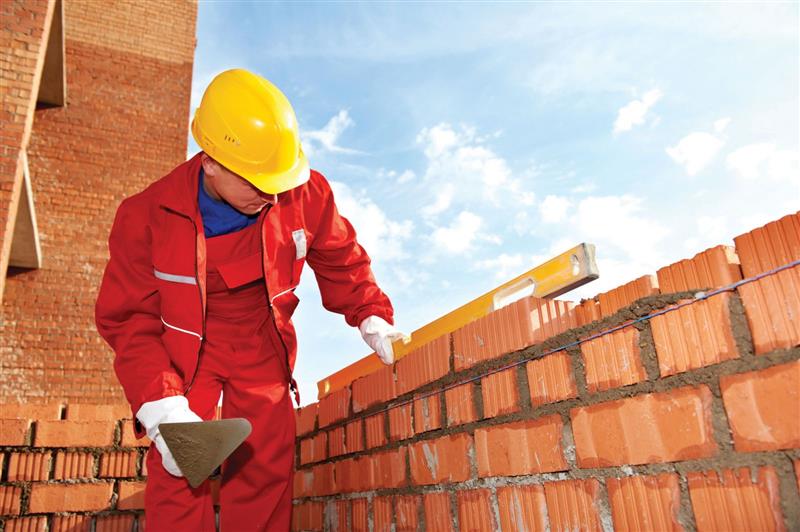
Service Description
The importance of the brickwork
Because they are largely used in the construction of buildings of various kinds, brickworks are among the most important construction works. Indeed, these works constitute the biggest part of shell house and also a part of the finished building.
Among the main special works of a mason, the main ones are the various kinds of brickwork, and some various auxiliary works. These works are part of different building elements that belongs to the mason namely: foundations, walls, pillars and columns, arches and vaults, chimneys etc.
From all this we can sum up that, on one hand that the masonry constitute the vast majority of work processes that compose the execution of a construction technology, on the other hand, it works closely with other construction specialties.
Definition and classification of the masonry
Masonry is generally made of blocks (bricks, stones, prefabricated etc.), arranged according to certain rules and combined with mortar which by drying attaches together the blocks, forming a massive monolithic (as would be composed of a single material ). From its source, these blocks can be natural – that are obtained directly from nature (example: stone) or artificial – that is produced in factories from converted natural materials (example: brick, precast).
Masonry can be made only from a single material that can be natural (processed clay) or artificial (concrete) and whose cure is achieved also a massive monolith. Finally, masonry can be made from blocks combined with mortar, in combination with a cast material (example: Mixed masonry of brick and concrete).
Classification of masonry can be done after several respects:
After the goal of the materials that compose them, masonry can be:
– Masonry, made of brick and mortar;
– Stone masonry, made of stone and mortar;
– Concrete masonry, composed of poured concrete;
– Precast masonry, consisting of precast (blocks, panels, boards) and mortar;
– Mixed masonry, made of several combined materials.
It should be observed that all of these masonries can be classified by source of masonry materials, as follows:
– Masonry from natural materials (stone);
– Artificial materials masonry (brick, concrete, precast).
By their role in construction, masonry is classified as it follows:
– Carrying masonry (bearing or resistance), which aims to support the building components abutting or in connection with, taking their weight and sending it to the foundations; so they are, for example, masonry pillars, walls for support of a building without skeleton etc .;
– Not carrying masonry (partitioning or fillers), which serves to separate the different parts of the building or to fill spaces between elements of supporting skeletal, leaning on the resistance elements of the building, without taking tasks beyond. Such is, for example, walls of reinforced concrete frames.
Before embracing various methods for performing masonry, it is necessary for the builder to know in detail how they are made. The third part will treat the composition of different kinds of masonry (brick, stone, concrete, prefabricated, mixed) showing in each case how to place the materials and the composition of elements made of different kinds of masonry ; in fourth part will describe the organization and methods of masonry executions.
Masonry from brick
Used from ancient times, the brick masonry, which is the basic work of a mason, is nowadays frequently encountered on construction sites due to its qualities, including: strength and durability, ease of execution, relatively low cost etc. However, new construction technique currently pursuing nowadays the replacement of ordinary brick masonry with lighter and cheaper masonry, which are built fast and satisfy the quality requirements of masonry. On this line, now they takes on a major expansion of masonry from light special bricks and precast.
Elements. Classifications
The brickwork is made of brick and different types of mortar.
A brick is composed of faces and edges.Four faces, which are the bed of bricks,the length, the width.
In masonry, bricks are placed side by side to form rows of bricks; the brickwork is made up of a number of such rows piled up to the top.
The bricks can be placed as follows: on edge (on edge, the bricks are placed with the width placed in height); on wide (lying); Wide bricks can be placed on: in length (head to head, in during the wall); across (side by side across the width of the wall) depending on the thickness of the wall.
These rows are named after their position in relationship to the masonry faces 4, 5 as follows: the row to the front or exterior /, interior row 1 and filling 5. The way the bricks are arranged in rows will show earlier different masonries.
Linking of the bricks in masonry is accomplished – as shown – with mortar. Filled spaces with mortar between bricks are called masonry joints. In a masonry there exist the following types of masonry joints, according to the position they occupy in masonry: masonry joints between rows, called horizontal joints or in length (since emerges over the entire length of the wall); joints between the bricks in the rows, called height or vertical joints (because emerges in the height of each row of bricks), which could be two longitudinal (i.e. located along the wall) and the cross (across or depth, i.e. in the width of the wall).
As they are or not filled with mortar, joints can be filled and empty joints, and after how worked up masonry joints can be: straight joints or in front, circular joints outgoing, joints round entrants (concave) , blunted joints, double blunted incoming joints or double blunted outgoing joints.
The masonry joints play an important role in achieving a good quality masonry. Therefore it will ensure the expected thickness for the masonry joints in each case, using the types of joints indicated. Rules for this effect shall be explained following.
For construction works they are used several kinds of brick masonry. These masonry can be classified as:
Depending on the type of used bricks, there are following categories of masonry:
– Masonry of full brick, made from ordinary full bricks;
– Masonry of hollow brick, executed from various types of hollow bricks (hollow, celled, drilled with tongue and groove, etc.).
Depending on the way how the bricks are placed in masonry, there are the following categories of masonry:
– A full masonry, in which bricks are arranged without spaces between them, nor in the thickness of the masonry, neither in its height; Gaps, in which the bricks are arranged so that in the masonry, that in the thickness and height , to obtain spaces which either remain empty or be filled with material having special properties.
Depending on the thickness of the masonry, there are the following categories of masonry, known in relation to the number of brick lengths entering their thickness in each row:
– (one quarter) brick, that is made up of bricks laid on edge (the edge), the thickness of the masonry being of 6,5 cm;
– Masonry 1F2 (one half) brick ,that is made up of bricks laid in long, the thickness of the masonry being of 12,5 cm;
– Masonry of one brick, that is made up of bricks stacked in two rows crosswise or in two straight rows, masonry thickness being of 25 cm;
– The masonry of P/2 brick (one and a half brick), that consists of a series of bricks laid lengthwise and arranged in a row crosswise, the thickness of the masonry is considered 37.5 cm;
– The masonry of 2 (two) bricks, that is made up of two rows of bricks arranged in a row in the aslant or crosswise and two lengthwise, the thickness of the masonry being considered by 50 cm;
– The masonry of 21/3bricks (two and a half brick) /, that is formed by a series of bricks laid lengthwise and crosswise arranged in two rows, the thickness of the masonry is 62.5 cm.
Brick masonry thickness may increase further (3, 31/2, four bricks etc.), but the most common being shown on the thickness masonry (1/4 – 2x / 2 bricks).
House Refurbishment in London. New Build in London.
Flat Refurbishment in London. New Build in London.
House Extension and Refurbishment in London.
Loft Conversion and Refurbishment in London.
House Renovation and Refurbishment in London.
Office Refurbishment, Shop Refurbishment in London.
Bathroom and Kitchen Refurbishment in London.
Electricians and Plumbers in London. Refurbishment London.
Kitchen Furniture Fitting in London. Cleaning in London.



Reviews
There are no reviews yet.