

Service Description
Roof insulation
We like that during the winter to ensure an optimal climate inside the house, a pleasant warmth, while in the summer we run after the cool. Well, to ensure this thermal comfort, a complex insulation is required, starting from the floor, walls and courageously climbing to the roof. Finishing with the roof insulation, you will get a pleasant and healthy atmosphere at the same time.
Roof insulation with polyurethane foam
According to some studies, besides the fact that more homeowners (whether in construction or old renovated houses) resort to insulation, the roof is one of the areas where the greatest amount of heat is lost. A roof that has not been isolated or not correctly isolated loses up to almost 30% of the heat in the house. Thus, not only the windows and doors are the reason why maintenance costs increase. Moreover, the investment in the roof insulation is amortized in about 5 years, after which you could talk about a small profit that you can spend as you like.
With this we can say that we answered to the question why you should isolate the roof. The next natural question is how to isolate it and I do not refer to the steps that the roof insulation implies, even though we will get there too.
Every house has a roof, obviously, but it can be horizontally, the terraced type or inclined, in waves. If we are talking about a horizontal roof, the insulation should only be done to the outdoors and this is usually done under waterproofing to avoid the water and moisture. In the case of insulation on the outside of the roof, it is recommended to use impermeable extruded polystyrene boards, expanded polystyrene and polyurethane boards.
This thermal insulation should take into account the level at which the doors are positioned, more precisely where the thresholds are coming in, so that they operate correctly and at the same time takes into account the traffic to which it will be subjected so that the insulation does not sink in time. The horizontal roofs, terraced type are usually made for your own pleasure, arranging an area with a panoramic view, for installation of different appliances, and last but not least for the installation of solar panels.
In case that we are considering a sloping roof, the insulation can be done both inside and outside between the covering, whatever its nature, and the roof boarding. This exterior roof insulation version is a relatively recent one, but has been especially created for those who want to use the space under the roof as a living area, the lofts of the houses are becoming more and more appealing for being transformed into attics.
Also, those who are looking for the “flat” sloping ceilings of wood beams will be extremely happy with this solution, especially if you also take into account the fact that you are no longer losing the living space. The useful area will be larger, as you do not lose space with the proper insulation, profiles and finally the plasterboards.
Thus, the polystyrene boards applied directly on the roof boarding will behave as a thermal barrier, they will protect the roof structure, while protecting the interior of the house from humidity, mold, cold or heat, depending on the season.
The insulation of the roof in the interior is much more common to us. Although the basic material used by most of us is the mineral glass wool, you should know that there are other variants.
I will start with two less used, the polyurethane foam insulation and the cellulose insulation.
- Roof insulation with polyurethane foam
The polyurethane foam can be applied to any kind of surface (wood, metal, concrete) fact which recommends it both for new and old roof insulation, for flat or inclined roofs, for indoors or outdoors.
Sprayed in a fairly thin layer, the foam behaves like a blanket that provides comfort to the interior while leaving the roof to breathe. Its biggest advantage is that, with a single spray, the entire surface is completely insulated, tight, even in the places that are hard to reach, without thermal bridges, and what ultimately results is a fine coat. However, it should be noted that this type of insulation is made only in the presence of a specialist, it can not be applied on the do it yourself principle. The good part is that it should not take more than a day.
- Cellulose roofing insulation
Also this, like the polyurethane foam insulation, requires the presence of a specialist who will pump with pressure the cellulose into your roof. More specifically, through a created window, the cellulose will be injected with pressure, reaching everywhere, even in the hard-to-reach places. It is extremely interesting that the material used is organic, treated to prevent the occurrence of the mold or insects and not only thermally insulates the roof, but also blocks the propagation of the sound, the cellulose being a very good acoustic insulator. In addition, what has contributed to remembering this type of insulation is its ecological nature, the reduced application time of only a few hours, the fact that there is no need for storage space, which implies less disturbance, the ability to distribute the water uniformly and the evaporation as quickly as possible, and also the cost starts from 8 euro / sq m.
- Roof insulation with polystyrene
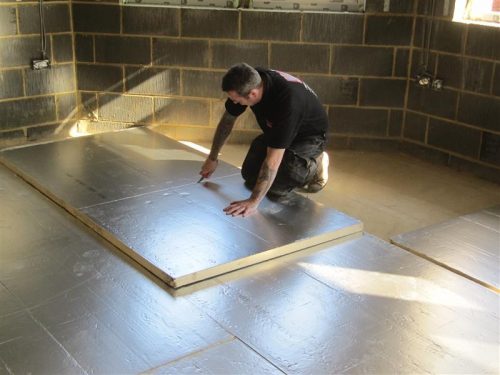
Although in terms of cost, the polystyrene may be the leader in top of roof insulation, it is not only less used but less efficient. It would be really useful if the average temperatures were higher. It is recommended for this 15 cm stage of polystyrene, which for a lived loft might represent something, especially if you also resort to the insulation of the walls and floors. As a way of applying it is installed in two layers. Place the first 10 cm layer between the roof rafters, if it is necessary cut the boards according to the space between the rafters. After the first layer the wooden sticks will be assembled whose role is to support the second row of polystyrene, this time of 5 cm. To avoid the thermal bridges, the second layer should not overlap with the first layer, more precisely the part where the first plate ends should be located at the middle of the plate of the second layer. In case that the situation so requires, apply a membrane / foil against steam over the two rows of polystyrene. Finally, the plasterboard system is installed.
- Roof insulation with mineral wool (basalt or glass)
The mineral wool has earned its reputation over time, thanks to the easy way it is installed, and it can be applied by both an experienced and an amateur person. In addition, the fire resistance (integrated into the category A1) is another criterion that puts it in the top of preferences. But the benefits of mineral wool do not just cover these two aspects, the thermal resistance, the acoustic insulation and the water resistance are the other aspects that recommend it in roof insulation.
Referring to the roof insulation as an realization process, the mineral wool is thus installed.
Depending on the type of wool that you have, boards or rollers, and the size of the insulating layer, the mineral wool can be applied in two layers for an increased thermal comfort. The first layer will be installed between the rafters, and its width should be about 2 cm larger than the distance between a rafter and another. If you are talking about a mineral wool roll, it can be applied from top to bottom (depending on how long it allows). It has to be slightly loaded into the reserved space, but not pressed.
In case that we are talking about these panels they will overlap each other. The second layer, for ease of installation and for avoiding the thermal bridges, will be done horizontally with the help of wooden slats in the rafters. In case that you choose a thicker coat of wool, on its edges, it is advisable to grab some nails, positioned equidistant from one another. They should not be wholly struck. On the side that will remain on the outside, a zigzag wire will be passed, which at the end should look like a net.
Finally, in case that you find it necessary, you can apply the steam barrier membrane, which should be applied over the whole surface of the roof over all the insulation. It is fitted tight with a double-sided adhesive tape.
In the long documentary, because it is not easy to isolate a roof, I have come to the conclusion that you will always need a specialized help all the time. The roof is a very important part of the house and not only has to be isolated, but it has to be built correctly. In addition, depending on the type of the slope and its degree of inclination, you must opt for a particular type of cover, which in its turn will influence the size of the insulation layer height, which, as is apparent from the hundreds of readings, it can be made of several insulating materials.
The most common combination is between the mineral wool with the polystyrene. Also, it is not only important to keep the heat in the house and the cold outside or the moisture at a distance, there must also be good ventilation, which is why on the roof boarding, before the cover you should put a special membrane. Inside, as some additional protection, I allow the aluminum foil or the cassava basalt mineral wool (provided with an aluminum layer), while others deny its utility. So I think it would be extremely timely for your path to intersect with a specialist to get the best solutions on a concrete case.
Regarding the cost side it can not be precisely defined. The price varies depending on the surface of the roof, the type of materials used, and the quantity, the layers of the insulation.




Reviews
There are no reviews yet.