

Service Description
The insulation in a loft conversion
If you are the lucky owner of a house with an attic and you have not turned that space into a beautiful attic yet, now is the time. After you’ve chosen the cover, sheet or tile and the roof was installed, we can think about the insulation of the floor / attic.
Steps to an attic ceiling insulation and finishing:
– The assembling of the expanded polystyrene. It is indicated to have a bigger thickness, for an efficient thermal insulation. I assembled polystyrene with a thickness of 10.
– Installation of the mineral wool. This one is also of different thicknesses. As the wool is thicker, the better the thermal insulation will be. I assembled wool of 10.
– The last step is represented by the installing the drywall.
Let’s see briefly what each step represents, and we will discuss them in detail in separate articles for each of them.
Materials required for loft insulation:
Polystyrene. Calculate the quantity of polystyrene for all of the ceiling area. Polystyrene is found most often in packs.
Mineral wool. Normally, the same square meters of polystyrene will be found in the square meters of wool. The mineral wool is found in rolls.
Drywall (gypsum boards). Besides the wallboardthere are also needed: metal profiles UD and CD (thin wall), CD suspension parts, screws, rods, dowels, sealing tape, drywall grout etc.
Please note: In bathrooms and kitchens it is used specially treated, green gypsum, against moisture.
Plasterboard ceiling and attic insulation assembling:
I will describe below the basics of installing plasterboard ceilings and of the insulation of the attic of a house, I will not go into technical details. I recommend contacting a team of specialists for installation, even if everything seems easy, from the distance.
Polystyrene. It was first assembled just below the deck. The deck, being beaten on the rulers (prop) of 10 × 10 cm, in the case of my house, and 10 cm thick polystyrene, it inserted perfectly between the rulers.
Mineral wool. It was fixed immediately after the polystyrene. Fixingthe mineral wool is as follows: Fix it in nails, on the rulers. The nails are not beaten to the end, then a – zigzag –net is formedwith a wire (blacksmith wire), fixed in the heads of the nails.
Wool thickness was of 10 cm (see photo gallery below for images with mineral wool).
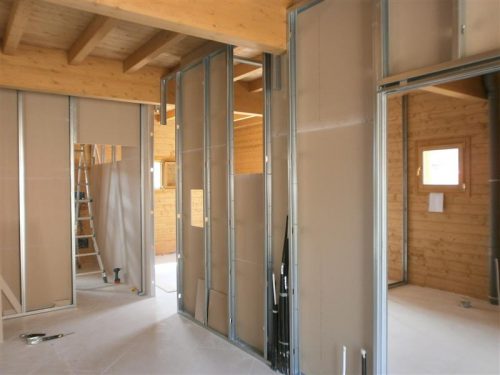
Drywall Installation is done using CD and UD profiles and other materials described above (see below picture profiles before installing plasterboard).
The attic shows high heat losses because 1. It is positioned above the building 2. The roof is thinner than the outer walls. Therefore, it requires a professional insulation with high quality materials, resistant to moisture, fire and to protect both heat and sound.
Moreover, as with other insulation (floors, walls) the attic insulation works as a long term investment because heating costs and thus maintenance bills will be much lower.
The best insulating material in attics and not only is the mineral wool (glass or basalt). This can either be inserted above the rafters – between the roof and the rafters- either between and beneath them – just as happens in the isolation of the beamed ceilings.
Experts recommend the second option, in which you have to addan insulation layer to avoid thermal bridging.
Steps towards proper attic insulation, with mineral wool, are:
- Firstly, check the existence of a waterproof sheet under the roof – this prevents the water penetration from the outside. If it is not there already, installing it is imperative. The assembling is performed above the rafters.
- The next step is cutting the insulating material, in our case the mineral wool. Keep a “margin of error” in which you should leave the material 2-3 cm longer to ensure perfect filling between the rafters.
- Point 3 refers to the insulating layer that we ware talking about a little bit before. For his installation, you will need little beams perpendicular to the rafters between which you should install insulation material.
- Last but not least, a vapour-proof membrane must be installed which should cover the entire insulated surface. The membrane joints will be sealed with a strip of double-sided adhesive and sticks (in combination with the walls of the house).
Once the attic insulation was accomplished, its arrangement will be realized as with any other interior without worrying about condensation, dampness appearance or about the inability of habitation in winter and summer at extreme temperatures.
House Extension and Refurbishment in London.
Loft Conversion and Refurbishment in London.
House Refurbishment in London. New Build in London.
Flat Refurbishment in London. New Build in London.
Electricians and Plumbers in London. Refurbishment London.
Kitchen Furniture Fitting in London. Cleaning in London.
House Renovation and Refurbishment in London.
Office Refurbishment, Shop Refurbishment in London.
Bathroom and Kitchen Refurbishment in London.




Reviews
There are no reviews yet.